Astrology
 Ayurveda
 Palmistry
 Vastu
Vastu
Views: 442
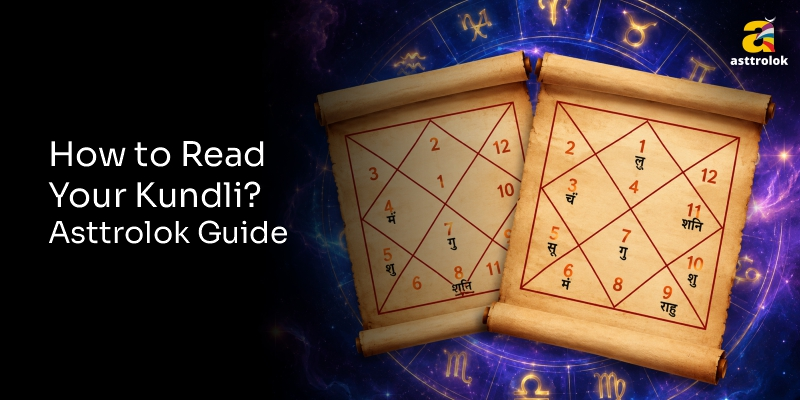
Many people receive a copy of their Janam Kundli and immediately look for predictions about career, marriage, wealth, or health. After a few minutes of looking at the chart, they often feel overwhelmed by unfamiliar symbols, numbers, planets, and houses. It may seem as though understanding a Kundli is something only experienced astrologers can do.
The truth is quite different.
Learning how to read your Kundli becomes much easier when you understand the basic principles of Vedic astrology. A birth chart is not just a prediction tool—it is a map that reflects your personality, strengths, challenges, opportunities, and important phases of life. Every planet, house, and zodiac sign contributes to the complete picture.
Whether you are simply curious about your horoscope or wish to study astrology seriously, this Asttrolok guide will help you understand the fundamentals in a simple and practical way. Following the traditional teachings promoted by Mr. Alok Khandelwal ji, the focus is always on understanding astrology logically instead of memorising complex rules.
What Is a Kundli?
A Kundli, also known as a Janam Kundli or birth chart, is prepared using your exact date of birth, time of birth, and place of birth. These details determine the position of planets at the moment you were born.
In Vedic astrology, your Kundli acts like a blueprint of your life. It helps astrologers analyse various aspects, including:
Career and profession
Education
Marriage and relationships
Financial growth
Health
Family life
Spiritual progress
Major life opportunities
Rather than predicting every event with certainty, a Kundli highlights natural tendencies and favourable periods so that better decisions can be made.
Step 1: Understand the Importance of Lagna
The first step in learning how to read your Kundli step by step is identifying the Lagna, also called the Ascendant.
The Lagna represents the zodiac sign rising on the eastern horizon at the exact time of your birth. It forms the starting point of the entire birth chart.
The Ascendant reflects:
Physical appearance
Personality
Behaviour
Confidence
Overall life direction
Every other house is counted from the Lagna, making it one of the most important elements in Vedic Kundli analysis.
Step 2: Learn the Meaning of the Twelve Houses
A Kundli contains twelve houses, and each governs a different area of life.
First House
Represents personality, health, confidence, and self-image.
Second House
Relates to wealth, speech, family values, and savings.
Third House
Shows courage, communication, skills, younger siblings, and determination.
Fourth House
Represents home, mother, emotional peace, property, and vehicles.
Fifth House
Indicates education, intelligence, creativity, romance, and children.
Sixth House
Represents competition, employment, health, debts, and enemies.
Seventh House
Shows marriage, partnerships, business relationships, and public interactions.
Eighth House
Associated with transformation, research, hidden knowledge, inheritance, and unexpected events.
Ninth House
Represents fortune, higher education, spirituality, teachers, and long-distance travel.
Tenth House
One of the most important houses for career, profession, reputation, authority, and achievements.
Eleventh House
Shows income, gains, ambitions, networking, and fulfilment of desires.
Twelfth House
Represents foreign travel, expenses, spirituality, meditation, isolation, and liberation.
Understanding these houses forms the foundation of every Kundli reading guide.
Step 3: Know What Each Planet Represents
Every planet symbolises a different energy. The results depend upon the house it occupies and its relationship with other planets.
Sun
Represents confidence, leadership, authority, recognition, and father.
Moon
Shows emotions, peace of mind, imagination, and relationship with the mother.
Mars
Represents courage, determination, energy, discipline, and competitive spirit.
Mercury
Controls intelligence, communication, business skills, learning ability, and analytical thinking.
Jupiter
Signifies wisdom, knowledge, teachers, spirituality, prosperity, ethics, and guidance.
Venus
Represents beauty, comforts, relationships, creativity, luxury, and artistic abilities.
Saturn
Shows discipline, responsibility, patience, hard work, justice, and long-term success.
Rahu
Represents ambition, innovation, foreign connections, material desires, and unconventional thinking.
Ketu
Indicates spirituality, detachment, intuition, inner wisdom, and liberation.
When learning how to analyse a Kundli, remember that no planet should be labelled as permanently good or bad. Their results always depend on their placement and overall chart combinations.
Step 4: Understand Zodiac Signs in the Birth Chart
The twelve zodiac signs influence how planetary energies are expressed.
For example:
Aries brings initiative.
Taurus provides stability.
Gemini enhances communication.
Cancer increases emotional sensitivity.
Leo supports leadership.
Virgo encourages practical thinking.
Libra seeks balance.
Scorpio represents transformation.
Sagittarius promotes wisdom.
Capricorn focuses on discipline.
Aquarius encourages innovation.
Pisces strengthens spirituality.
A planet behaves differently depending on the sign it occupies, making zodiac signs an essential part of Vedic horoscope analysis.
Step 5: Study Planetary Relationships
Many beginners only look at individual planets, but experienced astrologers always analyse planetary relationships.
Important combinations include:
Conjunctions
Planetary aspects
House ownership
Yogas
Strength of planets
Friendly and enemy relationships
These combinations explain why two people with the same zodiac sign may experience completely different life journeys.
Step 6: Learn About Dasha Periods
A common question people ask is why predictions change over time.
The answer lies in the Dasha system.
In Vedic astrology, Mahadasha and Antardasha determine which planet is influencing your life during a specific period.
A favourable planet may bring career growth, financial opportunities, or marriage, while a challenging period may encourage learning, patience, and transformation.
Understanding Dasha helps explain when important events are likely to occur rather than simply what may happen.
Step 7: Never Ignore Planetary Transits
Even a strong birth chart experiences changing results due to planetary movements.
These movements, known as Grah Gochar, influence ongoing events.
For example:
Jupiter may support education and financial expansion.
Saturn often teaches discipline and responsibility.
Mercury affects communication and business.
Mars increases determination and action.
Experienced astrologers combine birth chart analysis, Dasha periods, and current transits before giving meaningful guidance.
Common Mistakes Beginners Make While Reading a Kundli
Many newcomers become confused because they expect quick answers after learning a few basics.
Some common mistakes include:
Judging a single planet without analysing the entire chart.
Ignoring the Ascendant.
Looking only at zodiac signs.
Forgetting the importance of Dasha.
Confusing horoscope predictions with detailed Kundli analysis.
Assuming every online interpretation applies personally.
A Kundli should always be studied as one complete system rather than separate pieces.
You have not enough Humanizer words left. Upgrade your Surfer plan.
Bonus Tips for Understanding Your Kundli Better
Learning how to understand your Kundli is not about memorising rules overnight. It takes observation, patience, and consistent learning. Here are a few practical tips that can help you build confidence while reading a birth chart.
Always use your correct birth date, time, and place. Even a small difference in birth time can change the Lagna and house placements.
Study the complete chart instead of focusing on one planet. Every prediction is based on the relationship between houses, planets, signs, Dasha, and planetary transits.
Maintain a journal of important life events and compare them with your Dasha periods and planetary movements. This helps you understand astrology through real-life experience.
Avoid relying only on automated online reports. They provide general information but cannot replace detailed Vedic Kundli analysis by an experienced astrologer.
Learn astrology gradually. Begin with the Lagna, houses, planets, and zodiac signs before moving to advanced topics like Yogas, divisional charts, and Dasha systems.
If you genuinely wish to master astrology, structured learning makes a significant difference. Asttrolok offers online astrology classes where beginners and advanced learners study authentic Vedic astrology under expert guidance.
For those seeking clarity about their own horoscope, booking an online consultation can provide personalised insights based on your birth chart instead of generic predictions.
If you want an in-depth life analysis covering career, marriage, finances, health, education, and future opportunities, a personalized Kundali offers a much deeper understanding of your life's unique planetary influences.
कुंडली पढ़ना सीखना क्यों ज़रूरी है?
बहुत से लोग अपनी जन्म कुंडली केवल भविष्य जानने के लिए देखते हैं, लेकिन वास्तव में कुंडली आत्म-ज्ञान का माध्यम है। जब आप How to Read Your Kundli सीखते हैं, तो आपको अपनी क्षमताओं, कमजोरियों, करियर, शिक्षा, विवाह, आर्थिक स्थिति और जीवन के महत्वपूर्ण समय के बारे में बेहतर समझ मिलने लगती है।
वैदिक ज्योतिष में केवल एक ग्रह देखकर भविष्यवाणी नहीं की जाती। सही Janam Kundli analysis में लग्न, बारह भाव, ग्रहों की स्थिति, दृष्टि, दशा, अंतरदशा और गोचर सभी का संयुक्त अध्ययन किया जाता है। यही कारण है कि अनुभवी ज्योतिषी हमेशा सम्पूर्ण कुंडली का विश्लेषण करने की सलाह देते हैं।
Why Choose Asttrolok to Learn Kundli Reading?
Astrology is a vast science, and learning it from scattered online resources often creates more confusion than clarity. Asttrolok follows a structured teaching approach based on authentic Vedic astrology, making even complex concepts easier to understand.
Founded by Mr. Alok Khandelwal ji, Asttrolok has become a trusted learning platform for students, astrology enthusiasts, and aspiring professional astrologers. The focus is not only on theory but also on practical chart analysis using real-life examples.
Whether you wish to understand your own birth chart, pursue astrology as a career, or deepen your spiritual knowledge, Asttrolok provides guidance that combines traditional wisdom with practical application. Every learner is encouraged to think logically, analyse systematically, and interpret Kundlis with confidence rather than relying on memorised formulas.
Conclusion
Learning How to Read Your Kundli is a rewarding journey that helps you understand yourself on a much deeper level. A birth chart is far more than a collection of planets and symbols—it reflects your natural strengths, challenges, opportunities, and important life cycles. As your understanding grows, you begin to see how different planetary combinations influence career, relationships, education, finances, and personal development.
The best way to begin is by mastering the fundamentals. Learn the Lagna, understand the twelve houses, recognise the qualities of each planet, and gradually move towards Dasha analysis and planetary transits. With patience and regular practice, Kundli interpretation becomes both meaningful and insightful.
If you are serious about learning authentic Vedic astrology or want expert guidance for your own horoscope, Asttrolok is an excellent place to begin. Under the mentorship of Mr. Alok Khandelwal ji, learners gain practical knowledge, structured training, and a deeper understanding of astrology that supports informed life decisions.
Frequently Asked Questions
1. How do I read my Kundli as a beginner?
Start by identifying your Lagna (Ascendant), then study the twelve houses, planetary placements, zodiac signs, and their meanings. Once you understand these basics, gradually learn about planetary aspects, Yogas, Dasha periods, and transits for more accurate Kundli interpretation.
2. What is the first step in reading a Kundli?
The first step is identifying the Lagna because it determines the structure of the entire birth chart. From the Ascendant, astrologers analyse the twelve houses, planetary placements, and the overall direction of a person's life.
3. What do the twelve houses in a Kundli represent?
Each house governs a specific area of life such as personality, wealth, communication, education, career, marriage, health, spirituality, income, and expenses. Together, they provide a complete picture of different aspects of an individual's life.
4. Can I read my own Kundli?
Yes. Anyone can learn the basics of Kundli reading with proper guidance and consistent practice. However, advanced analysis involving Mahadasha, Antardasha, Yogas, divisional charts, and complex planetary combinations is best interpreted by an experienced Vedic astrologer.
5. Which house is responsible for career in a Kundli?
The Tenth House is the primary house for career, profession, reputation, and achievements. Astrologers also examine the Sixth House, Second House, Eleventh House, and the condition of important career-related planets before making predictions.
Comments (0)
.webp)
Categories
Recent posts

भाग्यांक कैसे ...
30 Aug 2023
Importance of Bhakoot Koota in Kundali ...
30 Aug 2023